
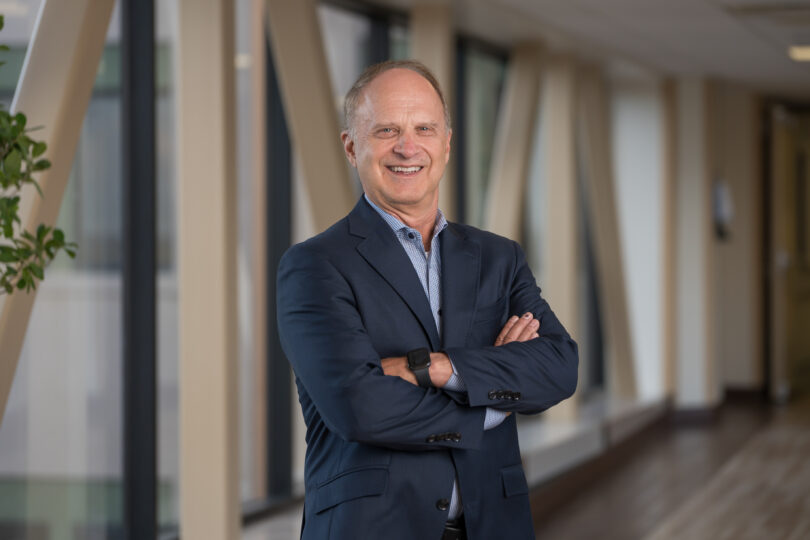
After college, Phoenix native Dave Cheney went to paramedic school. He initially planned on working as a paramedic for a few years and then moving on with his career. “I fell in love with being a paramedic. It never occurred to me, quite frankly, of how much joy I would get out of helping people on a day-to-day basis and making a difference in their lives on a day-to-day basis. I became addicted to health care. I think that’s where my heart is,” he says. After 13 years as a paramedic, he went into strategic planning and then worked on a cardiovascular service line. Next, he became an associate administrator and then a senior administrator at Good Samaritan Hospital in Phoenix. He served as the CEO at Banner Boswell in Sun City for about a decade. Next, he was the CEO of Sutter Medical Center in Sacramento. In this role, he eventually oversaw 24 hospitals. He returned to his home state in 2023 to serve as the CEO of Northern Arizona Healthcare (NAH).
“The more I learned about NAH, the more I fell in love with mostly the people. The people are just unbelievable. They give it their all. They’re compassionate. They’re caring. And honestly, I walk away every time just talking to them, just feeling inspired about what they do and how I can help them be the very best caregivers that they can be,” he says. As CEO, he reports to the board of directors. “My job is to make sure that I’m listening to the board and that I understand the vision of the board. And so that’s one piece, but the biggest piece, quite frankly, is removing barriers that our 3,500 employees have to do their jobs,” he says. “No matter what department you go, and whether it’s nursing, our physicians, our dietary people, they need someone that will help them solve problems and remove barriers so that they can be the very best when they deliver care. “And in my world, there’s really two categories of healthcare professionals. Either you deliver care directly, or you support somebody who delivers direct care, and they’re both so intertwined. The direct caregivers can’t do what they do without the people that provide the support and vice versa.” In his two years on the job, he told us he feels that some of his accomplishments are retaining current employees and changing the recruitment team in an effort to hire more providers. Another big effort is ensuring that providers aren’t getting burned out and feel inspired to make a difference. The second part of that is also ensuring that providers feel positive about their work environment. Having worked at other hospital systems in different parts of the country, we had to know what’s special about Northern Arizona.
“The biggest one is the challenge of our just immense geography. It’s gosh, 50,000 square miles, I believe, and there’s about 700,000 people in our service area and just getting access to health care to all the people that live literally hundreds of miles from providers to me,” he says. “We truly have something unique here. This service area up here is incredibly broad, and there’s a big need for health care, especially in our tribal areas, and we need to do a better job of making sure that everybody in Northern Arizona has the best access to care.” Dave told us he doesn’t like to talk about himself and prefers to focus on other people, but he did share that he currently resides on a farm just north of Flagstaff. He owns a couple of horses and miniature cows. When he’s not working, he spends his time there with his wife, children and grandchildren. By moving to Flagstaff, Dave has returned to his roots. He grew up on a ranch in the East Valley of Phoenix. Since the beginning of his career, he’s always found great joy in helping others. “Whether I was working the front lines, or whether, at this level, I find that if I can help the providers make a difference in someone’s life, then I walk away every day feeling this was a really good day. We actually did something that positively affected a patient, a family member, the community in general. It’s a calling,” he says. “That’s what motivates me to come to work every single day, to help the people that are actually working with patients and families in the community be their very best.”